
Overview
Consultancy
Publicis Sapient
Period
2023 – 2024
My Role
I was the UX and Product Design Lead, working alongside UI Lead James Bearsley and Content Design Lead Elena Goodrum, under the guidance of Creative Director David Mingay. We led the design from start to finish, working briefly with strategy to conduct user research and market analysis. In less than 6 months we designed and shipped the end-to-end MVP experience, working side-by-side with an offshore tech team. I continued post-launch as the sole designer, delivering additional features and helping to define the roadmap.
Category
App Design · New Product Proposition
Status
📦 Shipped, 2023 – 2024


Brief
The Royal Horticultural Society is one of the world's leading authorities on gardening, but its reach has historically centred on members who live near its five show gardens.
They have a robust website and basic ‘My Garden’ service. However, usability issues and a focus on expert gardeners limited its popularity, especially among novices and small-space gardeners. Publicis Sapient was approached to transform their 'My Garden' service into a mobile app, one with broader appeal that put the RHS’s expertise directly in the hands of the UK’s 30 million gardeners.
The challenge was achieving it on a lean budget and a tight timeline, in an app market already crowded with plant-care and identification tools. Standing out quickly, and affordably, was the constraint that shaped the product strategy from the outset.

Discovery

We started by synthesising the RHS's existing user research and mapping it against their strategic goals. Four behavioural mindsets emerged (experienced gardeners, novices, urban gardeners, and the environmentally-conscious), each with distinct needs and pain points. These became the lens we scoped the product against.
Working alongside our strategy and product team, I led the UX side of discovery: competitor and market analysis, an audit of the existing 'My Garden' web experience, feature ideation and prioritisation, and information architecture. This fed into a prioritised backlog and a clear MVP scope.
Design
We ran a lean agile process – two-week design sprints across roughly ten weeks for MVP, with the usual cadence of standups, grooming, sprint planning and end-of-sprint showcases that kept the RHS close to the work throughout.
I worked side by side with UI Lead James Bearsley across the whole design effort, from information architecture and experience journeys through to user flows and co-designing the UI itself. We ran ideation workshops with the RHS team to pressure-test feature flows and ensure that the experience was surfacing the right level of expertise at the right time, and kept engineering in the room throughout so we were designing against real technical constraints rather than discovering them later.

Design Challenge 1
—
Easy for beginners, without losing the expert
The hardest tension was serving novices and experienced gardeners in the same interface.

A simple search by default with advanced filtering a tap away.
Plant profiles that led with the essentials but kept richer detail within easy reach – useful for an expert, never overwhelming for a beginner.


The same notion shaped a 'botanical names' toggle on every page where plants were listed.
Each plant has both a common name and a Latin botanical name, so by default a beginner could lead with the familiar common name, while a seasoned gardener could switch the botanical name to the front – the same plant, led by whichever name felt most familiar.
Design Challenge 2
—
Designing for different mental models
People organise their plants in different ways, so rather than enforce one structure we built in flexibility.

A key decision was how to separate plants people own from plants they want. We tested splitting My Plants and Wishlist into two top-level sections, versus folding the Wishlist within My Plants.
After some rapid user testing, we evaluated that a condensed approach of making Wishlist plants visible from the wider ‘My Plants’ page enabled more straightforward navigation, keeping the boundary between "have" and "want" fluid.
Care Tips can be viewed by 'plant' or by 'care category', depending on user preference, enabling users to pinpoint care tips faster.


Plant notes, introduced as an enhancement feature, also provided flexible discoverability.
Either via a plant profile; or from within My Garden (previously named My Plants) under the tab ‘Journal’.
Notes were also split between garden-level and plant-specific notes so it matched how people actually think about their gardens.
Design Challenge 3
—
Confidence in the advice
Because the app's value rests on trust, we designed the AI features to be honest about their limits.
Plant ID originally showed a percentage match on each suggestion – "We've found a match" above a confident result; "We're not sure about this plant" above a weaker one.
Testing revealed the percentages backfired: people didn't know how to read an "87% match” or a "37% match”, and a long list of low numbers eroded the very confidence we were trying to build.
So we dropped the percentages entirely. Confident results now lead with "We've found a match" and a single ‘high-confidence’ badge on the top suggestion; uncertain ones say "We've narrowed it down" – both capped at seven options.


For the AI plant advisor feature, ChatBotanist, we gave users the option to regenerate an answer and provide feedback, keeping a human sense of control over an automated advisor and giving the RHS a steady signal to improve it.
Result
The MVP of RHS Grow launched on iOS and Android in May 2023, bringing the RHS's pedigree of horticultural expertise to a far wider audience than just its garden visitors and existing members. More advanced features arrived as a second MLP stage, such as the AI plant advisor ChatBotanist in September that year, followed by a hands-free experience in 2024. Beyond the MVP, I stayed on as the sole designer to refine the core features and shape that roadmap.

The brief was to bring a storied institution into a modern app without diluting the trust that makes it valuable. Launching free first let RHS Grow build an audience and gather real feedback quickly, while features like the ChatBotanist proved the RHS's depth of expertise could be delivered in a new form.
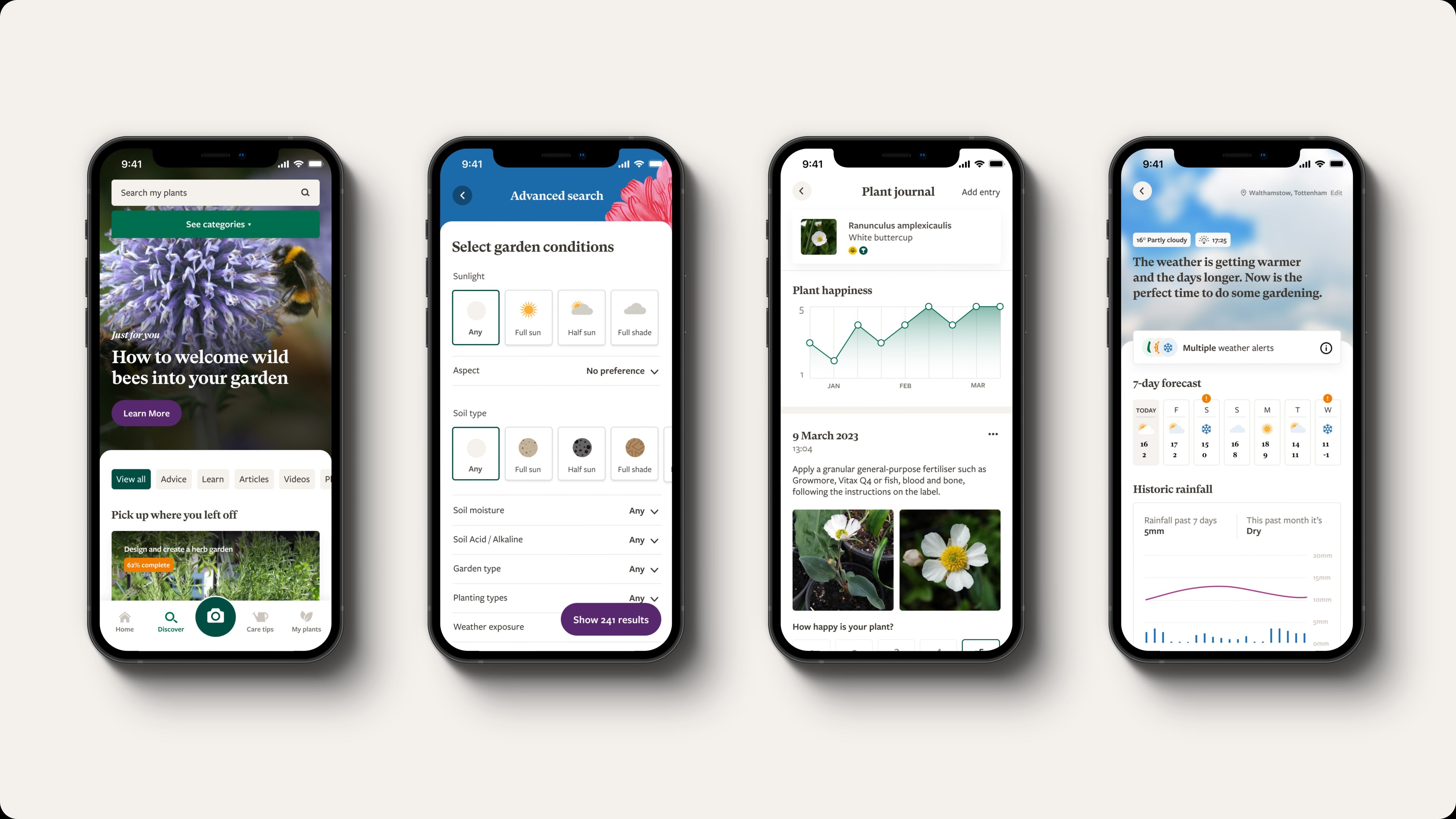


What I took from it was the discipline of modernising something old without overwriting it; moving quickly on new technology while protecting what the RHS had spent generations building; and designing for a hugely varied audience, from first-time growers to lifelong gardeners, without compromising either. Leading it from discovery to a shipped MVP in under six months taught me as much about prioritisation and trade-offs as it did about craft.


